Understanding CMMI: A Commitment to Quality Assurance


In the fast-paced world of custom software development, ensuring consistent quality and predictable outcomes is what separates industry leaders from the rest. Discover how the Capability Maturity Model Integration (CMMI) framework provides a proven roadmap for software quality assurance and why Soluntech’s Level 3 rating guarantees robust, scalable solutions for your business.
Key Takeaways
- Capability Maturity Model Integration (CMMI) is a global framework that optimizes business performance and ensures predictable project outcomes.
- Implementing CMMI in software quality assurance guarantees structured, repeatable processes that minimize risks and elevate product reliability.
- The framework consists of five distinct maturity levels, guiding organizations from chaotic operations to a culture of continuous optimization.
- Soluntech’s CMMI Maturity Level 3 rating demonstrates our commitment to standardized best practices and tailoring robust solutions for our clients.
What is CMMI??
CMMI, or Capability Maturity Model Integration, is a proven set of global best practices that drives business performance through building and benchmarking key capabilities.
CMMI helps organizations understand their current level of capability and performance and offers a reliable guide to optimize business results. By standardizing procedures, it creates a solid foundation for robust custom software development projects.
The 5 CMMI Maturity Levels Explained
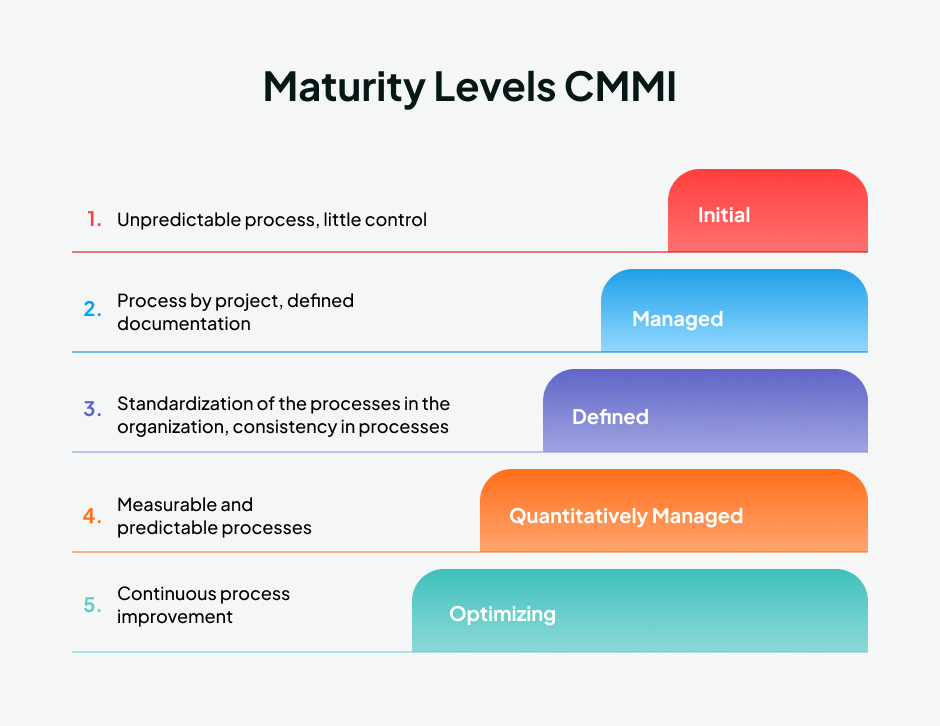
CMMI consists of five distinct maturity levels, each designed to provide a clear pathway to process improvement and elevated standards:
- Initial (Level 1): Processes are ad-hoc, chaotic, or even undefined. There's a high reliance on individual effort and heroics to get things done.
- Managed (Level 2): The company follows some processes that are often project-specific. There's still room for consistency and efficiency.
- Defined (Level 3): Processes are well-defined, understood, and used throughout the organization. A focus on standardization emerges, contributing greatly to overall reliability.
- Quantitatively Managed (Level 4): The organization collects metrics and uses them for continual process improvement. Performance is predictable.
- Optimizing (Level 5): Continuous improvement is ingrained in the culture. There's an active focus on process optimization and organizational excellence.
 Why is CMMI Quality Assurance Important?
CMMI is not merely a certification; it's a continuous journey toward excellence. Its importance manifests in several vital aspects:
- Quality Assurance: CMMI ensures consistent software development quality by following globally recognized best practices.
- Efficiency Improvement: Process improvement and focus on continuous learning lead to streamlined operations and better outcomes. This pairs perfectly with modern workflow automation strategies.
- Risk Mitigation: Through structured planning and management, potential risks are identified and managed proactively.
What CMMI Guarantees for Your Projects
CMMI is an assurance of integrity, commitment, and excellence. It offers guarantees in several critical areas:
- Structured Processes: CMMI helps implement disciplined, repeatable processes, ensuring project consistency and quality control.
- Customer Satisfaction: It aids in building solutions that not only meet but often exceed customer expectations.
- Robust Solutions: Focusing on quality at every stage ensures the development of secure, high-performing, and reliable software.
Key Benefits of CMMI in Software Quality Assurance
CMMI certification is not just an achievement but an ongoing advantage. Applying CMMI in software quality assurance brings far-reaching benefits:
- Competitive Edge: CMMI helps set your organization apart in an increasingly competitive market, especially when providing software development for startups.
- Cost Savings: Through process improvement, reducing errors, and enhancing efficiency, CMMI leads to significant cost savings.
- Increased Trust: Clients and partners view CMMI certification as a mark of CMMI quality assurance, leading to increased trust and collaboration.
- Global Recognition: Being aligned with a globally recognized standard opens doors to international opportunities and partnerships.
How Soluntech Leverages CMMI for Software Excellence
Our Alignment with CMMI: Achieving Maturity Level 3
At Soluntech, our alignment with CMMI is not just a strategic decision but a testament to our commitment to excellence and continuous improvement. We are proud to have achieved a CMMI Maturity Level 3 rating, demonstrating our adherence to well-defined and standardized processes across the organization.
 Soluntech CMMI Maturity Level 3
How We Utilize CMMI in Custom Software Development
- Incorporating Best Practices: Our team keeps abreast of global standards, ensuring our methodologies align with CMMI Maturity Level 3 principles. This mindset extends to our QA AI testing procedures as well.
- Tailoring Client Solutions: Through the disciplined approach endorsed by CMMI Level 3, we craft precise solutions for our client's unique needs, leading to effective Risk Mitigation.
- Engaging in Continuous Learning: At Soluntech, we understand that excellence is an ongoing pursuit. With CMMI Maturity Level 3 as our benchmark, we invest in continuous training, metrics-driven analysis, and Process Improvement.
Are you passionate about excellence? We share that drive at Soluntech. Our CMMI Level 3 certification ensures we deliver the quality, efficiency, and innovation you need in your software solutions. Contact us today to turn your vision into reality.
Questions this article raises.
What does a CMMI Maturity Level 3 rating signify for a company like Soluntech?+
A CMMI Level 3 rating indicates that the company has well-defined processes and procedures, aligning its practices with industry standards. This ensures consistency, reduced risk, and top-tier quality in all custom software deliverables.
What is CMMI in software quality assurance used for?+
In software engineering, CMMI provides a clear framework to measure and improve the maturity of development processes. It guarantees that software is built using repeatable, disciplined methods, which drastically minimizes bugs and project delays. This is particularly critical when handling complex projects like legacy system modernization.
What are the common challenges faced while implementing CMMI, and how can they be overcome?+
Implementing CMMI can be challenging due to resistance to change, lack of resources, or poor understanding of the framework. Success often requires strong leadership commitment, ongoing employee training, and a well-planned implementation strategy.
Can partners verify Soluntech's CMMI rating?+
Yes, CMMI ratings can be verified through the certifying body or the organization's public records, ensuring total transparency and authenticity for our clients.
How does Soluntech integrate CMMI practices with other industry standards?+
Soluntech strategically integrates CMMI practices with other relevant industry standards, such as ISO certifications. This creates a cohesive framework for quality management, ensuring that various standards complement each other and reinforce our commitment to excellence.
Soluntech Team
AI-Native Engineering Firm
Soluntech's team writes about software, AI systems, validation, and operational technology from the perspective of disciplined engineering and long-term system ownership.
Continue with related insights.
Explore more thinking connected to this topic, from software decisions to AI systems and operational execution.

AI Didn’t Fix Software Estimation. It Just Moved the Risk.
AI tools can now generate detailed software estimates in minutes.
Soluntech Team
AI-Native Engineering Firm

Designing Decision Systems: From AI Insights to Action
Designing Decision Systems: From AI Insights to Action
Soluntech Team
AI-Native Engineering Firm

Designing Intelligence vs. Automation: AI Strategic Value
Designing Intelligence vs. Automation: AI Strategic Value
Soluntech Team
AI-Native Engineering Firm