Why Startup Growth Feels Slow… Until It Doesn’t

"We’ve been working for months, but growth still feels flat. Maybe this isn’t working."
The frustration is real. But the truth is, startup growth almost never moves in a straight line.
It follows what’s known as the J-curve.
Key Takeaways:
- Startup growth is rarely linear. Early progress is often invisible, and visible acceleration usually comes after years of groundwork.
- Flat growth is not wasted effort. Validation and iteration are what make later compounding possible.
- Giving up too soon and scaling too early are the two main traps. Both come from misreading the slow phase.
- Validate the customer problem before investing in scale. Speed only pays off once the product has earned it.
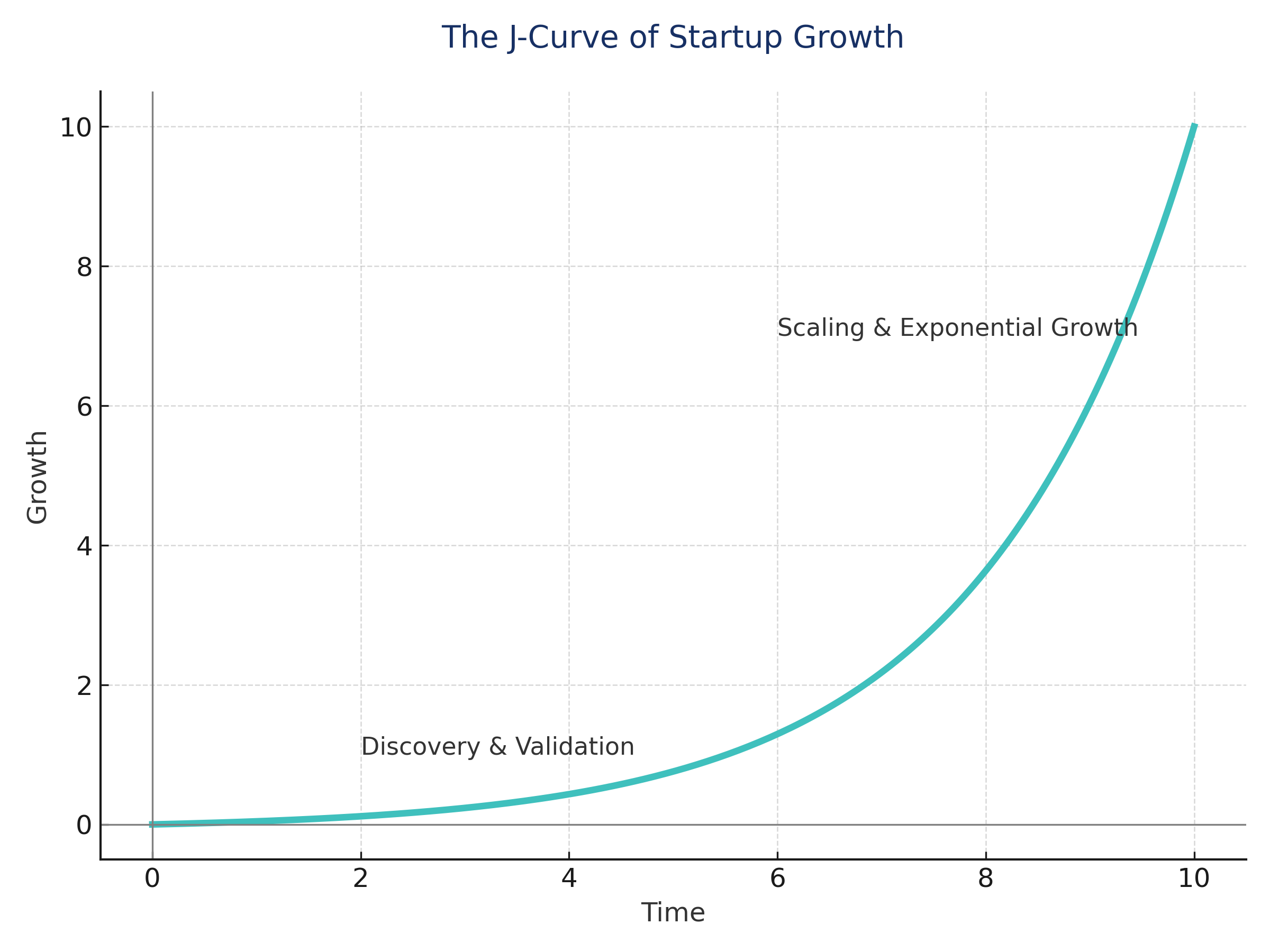
The J-Curve of Startup Growth
At first, progress feels imperceptible. You’re talking to users, iterating on an MVP, revising your business model. Each day feels like small wins and dead ends.
Then—suddenly—the curve bends upward. Adoption accelerates. Revenue compounds. What once felt like stagnation turns into unstoppable momentum.
That’s the power of compounding in startups: years of invisible groundwork, followed by visible acceleration.
Why Early Growth Feels Stuck
- Discovery & Validation take time. In these stages, you’re testing hypotheses, not scaling. The goal isn’t growth—it’s learning.
- Linear expectations don’t fit. Most founders expect straight-line progress, but real startup growth compounds, looking flat until it explodes.
- The myth of overnight success. Behind every “sudden” breakout is usually years of invisible preparation.
Early validation is often the hardest part to get right, so it’s worth reading how to approach it in our guide to Customer Discovery — Setting Up Your Startup For Success.
The Danger Zone
Many founders misinterpret the slow phase:
- Some give up too soon, thinking the idea has failed.
- Others scale too early, burning cash before reaching product/market fit. This is one of the traps covered in The 9 Deadliest Startup Sins.
This is where companies like Webvan collapsed—trying to accelerate before the curve was ready.
Surviving to the Steep Part
The difference between failure and “overnight success” often comes down to patience and discipline:
- Focus on validating the customer problem before scaling.
- Treat every iteration as compounding, even if the curve looks flat.
Remember, slow growth is not wasted growth—it’s the foundation.
Final Takeaway
Startup growth is rarely visible in the beginning. But if you survive the flat part of the curve, the compounding effect can feel unstoppable.
Don’t confuse patience with inaction. The real danger isn’t moving too slowly—it’s assuming speed before you’ve earned it.
How Soluntech Helps
At Soluntech, we work with founders to navigate the J-curve with clarity and discipline:
✓ Visual Proofs of Concept to validate faster
✓ Iterative MVPs that cut time-to-learning
✓ Post-MVP support to survive the flat stage and reach product/market fit
Ready to design for the curve and accelerate growth the right way?
Questions this article raises.
Why does startup growth look flat in the beginning?+
Early on, the work is mostly discovery and validation: testing hypotheses and learning what customers need. That work rarely shows up as visible growth, but it builds the base for later acceleration.
What is the J-curve in startup growth?+
It describes slow, often invisible progress at first, followed by a sharp upward bend once adoption and revenue start to compound.
When is it a mistake to give up on a startup?+
When you stop before you have tested the core customer problem. Giving up too early often means quitting before the curve has had time to bend.
Why is scaling too early dangerous?+
Scaling before reaching product-market fit burns cash on a product that customers do not yet need. Webvan is a well-known example of trying to accelerate before the curve was ready.
How can founders tell patience from inaction?+
Patience means every iteration is aimed at learning and validating the customer problem. Inaction means repeating the same work without new insights or evidence.
Soluntech Team
AI-Native Engineering Firm
Soluntech's team writes about software, AI systems, validation, and operational technology from the perspective of disciplined engineering and long-term system ownership.
Continue with related insights.
Explore more thinking connected to this topic, from software decisions to AI systems and operational execution.

Love in the Age of AI
How Artificial Intelligence is Transforming Human Relationships
Soluntech Team
AI-Native Engineering Firm

Designing the Enterprise Learning Loop: Scalable AI Growth
Designing the Enterprise Learning Loop: Scalable AI Growth
Soluntech Team
AI-Native Engineering Firm

Learning Velocity: The Only Metric That Matters for AI Growth
Learning Velocity: The Only Metric That Matters
Soluntech Team
AI-Native Engineering Firm