MVP Strategy
Define the smallest responsible investment that creates meaningful learning before scaling development.
An MVP is not the smallest product. It is the smallest investment capable of reducing the most important uncertainty.
Soluntech helps leaders define what should be learned first, what scope is responsible, and when the organization has enough evidence to increase investment.

MVP logic
Scope should follow uncertainty, learning, and investment risk.
Most MVPs fail because they try to prove too much.
Organizations often misunderstand the purpose of an MVP. It is not meant to prove that the entire business will succeed, and it is not a lower-cost version of the final product.
A responsible MVP exists to reduce one or two critical uncertainties before larger investments are made. When the first version keeps growing, the MVP becomes an expensive first release instead of a structured learning initiative.
MVP Strategy reduces execution risk by connecting scope to uncertainty. The question is not how little can be built. The question is what must be learned before the next investment decision.
When MVP Strategy becomes necessary
Minimum Viable Product Strategy matters when the organization has a credible direction, but not enough certainty to justify full-scale development.
The opportunity may deserve investment, but the first version should be shaped by what the organization still needs to learn.
What we clarify first
- Which unknowns should determine first scope
- What evidence would justify more investment
- Which assumptions are too risky to ignore
MVP Strategy should define the smallest build that creates the most useful evidence.
What we define
Scope follows uncertainty, not the other way around.
Soluntech provides MVP Consulting, MVP Planning, Software MVP Strategy, and MVP Definition for organizations that need to decide what the first responsible investment should include.
We help define learning objectives, validation priorities, smallest meaningful scope, success metrics, assumptions addressed, technical boundaries, operational constraints, investment sequence, and the roadmap beyond the MVP.
Strong MVP Strategy often depends on prior Product Discovery and Testing Assumptions. If the problem, outcome, or highest-risk beliefs are still unclear, those steps should shape the MVP before engineering begins.
Not sure whether the initiative is ready for an MVP? Start the Validation Assessment to identify whether more discovery or assumption testing is needed first.
Learning Objectives
The decisions the MVP needs to inform before more investment is justified.
A disciplined MVP is not a smaller dream. It is a sharper investment in learning what matters next.
Decision artifacts we commonly produce
- Learning Objectives01
- Validation Roadmap02
- MVP Scope Definition03
- Investment Priorities04
- Success Metrics05
From uncertainty to focused execution
Our approach keeps MVP decisions tied to the evidence leadership needs before scaling development.
Define what must be learned
We identify the decisions the MVP needs to inform and the uncertainty that most affects the next investment choice.
Prioritize investment
We separate essential learning from future functionality so the first version does not carry the burden of the full roadmap.
Design the smallest responsible MVP
We define a version that creates meaningful evidence without unnecessary engineering, complexity, or premature scale.
What MVP Strategy makes possible
MVP Strategy helps the organization learn faster without confusing movement with evidence or scope with confidence.
Faster validated learning
The first investment is designed to answer the questions that matter most.
Lower investment risk
Leadership can avoid committing full-scale budget before evidence supports the next step.
Clearer roadmap evolution
The roadmap can evolve based on what the MVP teaches, not only what the team hoped would happen.
Reduced unnecessary scope
Features that do not support the primary learning objective can wait until the evidence justifies them.
Stronger stakeholder confidence
Teams can align around what the MVP is meant to prove, learn, or clarify.
More disciplined engineering investment
Engineering effort is directed toward learning and decision quality before the organization scales development.
Built in Practice
These examples show how disciplined scope, validation, and engineering decisions can lead to stronger products and systems.

Gave doctors back 2+ hours per day from documentation
A clinical team struggling with time-consuming documentation and workflow disruption. We implemented an AI-native solution that automated the heavy lifting of clinical notes.

Made a system 40% faster for therapists
A mental health platform slowed down by inefficient workflows and poor usability. We re-engineered the core architecture to prioritize speed and therapist focus.
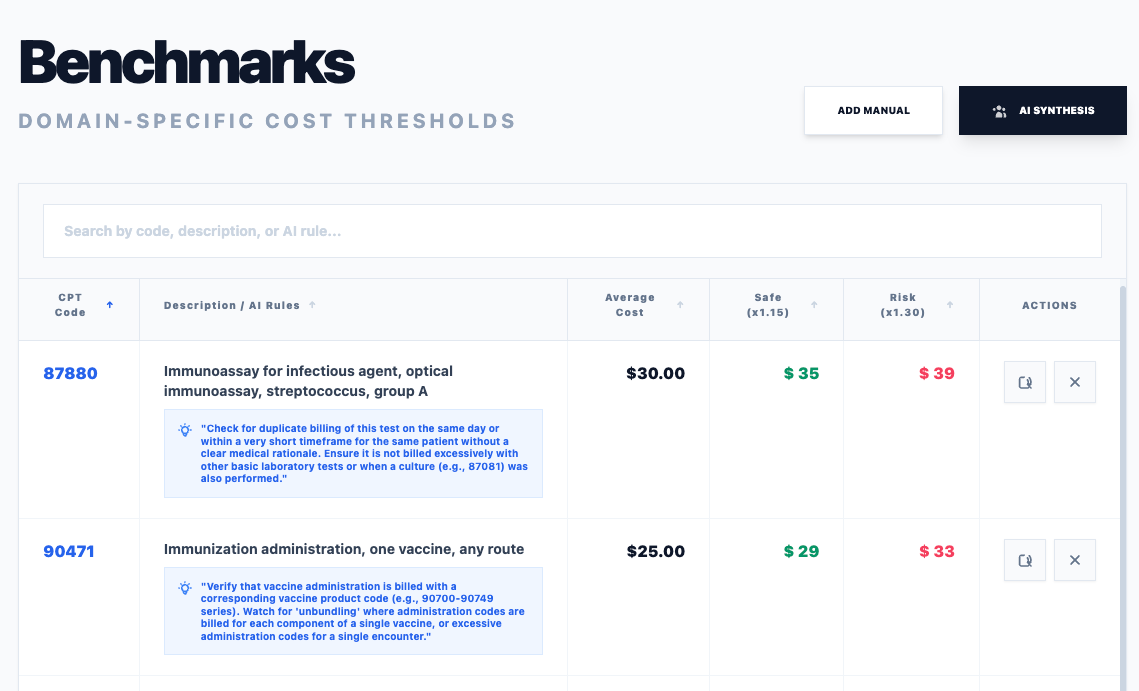
Made hidden revenue visible and actionable
Organizations unable to identify revenue opportunities hidden in documents. We built a data intelligence layer that surfaced actionable insights in real-time.
Frequently Asked Questions
What is MVP Strategy?
MVP Strategy defines the smallest responsible investment that can create meaningful learning before the organization commits to larger-scale development. It connects scope to uncertainty, success metrics, assumptions, and the next investment decision.
How is MVP Strategy different from MVP Development?
MVP Strategy decides what should be learned, what belongs in the first version, and why that scope is justified. MVP Development is the engineering work of building that version once the strategy is clear enough.
Why do many MVPs become too large?
MVPs grow when teams try to satisfy the full future roadmap, every stakeholder preference, or every imagined user need at once. Without clear learning objectives, the MVP becomes a small version of the final product instead of a focused test of uncertainty.
How do we decide what belongs in the MVP?
Scope should be based on the uncertainty the MVP must reduce. Features belong when they are necessary to test the core learning objective, validate the investment logic, or support the decision the organization needs to make next.
Can the strategy recommend delaying development?
Yes. If discovery or assumption testing shows that the problem, user behavior, business case, technical feasibility, or expected outcome is still too unclear, delaying development may be the responsible recommendation.
How does MVP Strategy relate to Product Discovery?
Product Discovery clarifies the problem, outcome, users, operating context, and investment logic. MVP Strategy uses that clarity to define the smallest responsible build that can create useful evidence.
How does MVP Strategy relate to Testing Assumptions?
Testing Assumptions identifies which beliefs could invalidate the initiative. MVP Strategy uses those priorities to decide what the first version should test and what should wait.
How does the Validation Assessment support MVP planning?
The Validation Assessment helps teams understand whether they are ready to define an MVP or whether more discovery and assumption testing are needed first. It organizes uncertainty before scope decisions become expensive.
Read before defining the MVP
These perspectives help leaders think through MVP boundaries, validation, uncertainty, and the cost of building too much before evidence exists.



Ready to define the smallest responsible investment?
Use the assessment to clarify readiness, or speak with us when the MVP decision needs stronger strategy before engineering begins.